Route
Odysseus' Journey Map: Every Stop from Troy to Ithaca
Ithaca is not only a point on a map.
Each stop costs something. The journey home is also a journey through the self.
Updated July 4, 2026
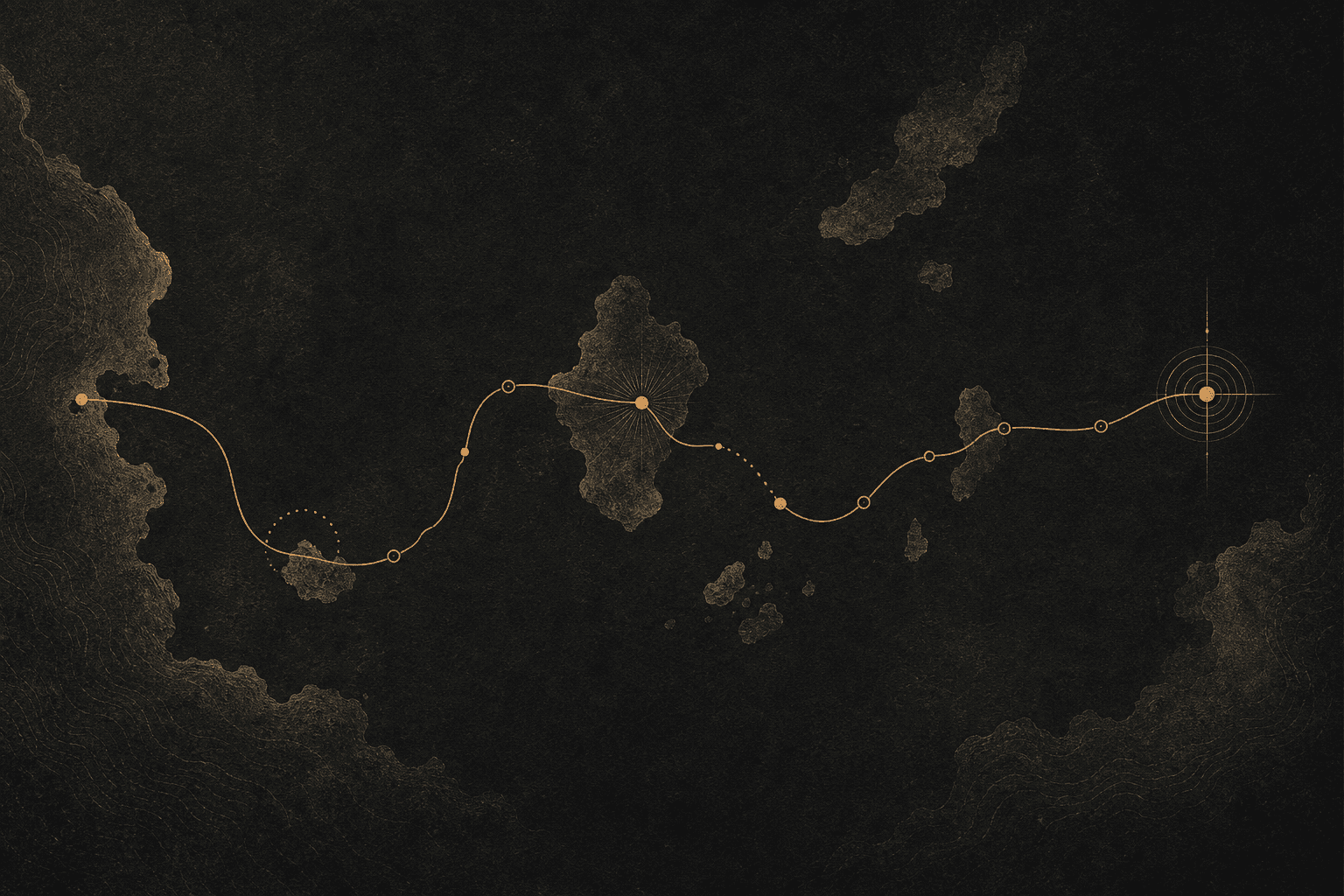
The short answer
Odysseus' journey runs from Troy to the Cicones, the Lotus-eaters, the Cyclops, Aeolus, the Laestrygonians, Circe's island, the land of the dead, the Sirens, Scylla and Charybdis, Thrinacia, seven years on Calypso's Ogygia, and finally Phaeacia, whose sailors carry him home to Ithaca. The voyage takes ten years, costs him every ship and every man, and its real-world geography has been debated — and never settled — since antiquity.
Four things to hold onto
- The route has fourteen major stops and takes ten years — but roughly eight of those years are spent standing still, not sailing
- Most of the journey is told as a flashback: Odysseus narrates Books 9–12 himself, at a banquet on Phaeacia
- Every stop has a price — by Ithaca, all twelve ships and every companion are gone
- Real-world locations for the stops are speculative; traditions map them onto the Mediterranean, but the poem never confirms any of it
Most people carry a three-stop Odyssey: a Cyclops, some Sirens, a homecoming. The real route is longer and stranger — fourteen stations between the burning of Troy and the beach at Ithaca, each taking something from the man who passes through.
Below is the route in order — each stop, what happens, what it costs. Two things first. The poem starts near its end, letting Odysseus narrate the disasters as a flashback at a stranger's banquet (Books 9–12). And the map is mostly not sailing — of the ten years, roughly eight are spent standing still.
Troy
Book 9
The ten-year war is over. Odysseus sails for home with twelve ships and a fair wind — a crossing that should take weeks.
What it takes: nothing yet. Troy has already taken ten years; the sea will take ten more.
Geography is schematic — Homer's, not Google's. Scholars have argued about the real locations for two millennia; the shape of the route is the point.
All fourteen stops
Stop 01 · Book 9
Troy
The ten-year war is over. Odysseus sails for home with twelve ships and a fair wind — a crossing that should take weeks.
What it takes: nothing yet. Troy has already taken ten years; the sea will take ten more.
Stop 02 · Book 9
The Cicones
Fresh from Troy, the fleet sacks the city of Ismarus. The men refuse the order to leave; the Cicones regroup and counterattack, and seventy-two men die before the ships escape.
What it takes: the illusion that the war's rules still work in peacetime.
Stop 03 · Book 9
The Lotus-Eaters
Scouts eat the lotus and lose all desire to return. They weep when Odysseus drags them back to the ships and ties them under the benches.
What it takes: the first proof that not every man wants to be saved.
Stop 04 · Book 9
The Cyclops (Polyphemus)
Trapped in Polyphemus's cave, Odysseus blinds the giant, escapes under the sheep with the trick of the name "Nobody" — then shouts his real name across the water. The Cyclops prays to his father, Poseidon, for a curse.
What it takes: six men eaten, and the sea itself turned enemy.
Stop 05 · Book 10
Aeolus
The wind-king seals every contrary wind in a bag. Within sight of Ithaca's fires, Odysseus sleeps; the crew, suspecting treasure, open it, and the storm blows them all the way back.
What it takes: the crew's trust — and the closest they will ever come together.
Stop 06 · Book 10
The Laestrygonians
A harbor of cannibal giants. They spear the ships like fish, and only Odysseus's own vessel, moored outside the harbor, escapes.
What it takes: the fleet. From here on, one ship carries the story.
Stop 07 · Book 10
Circe
The witch turns half the crew into swine. With Hermes's help Odysseus resists her drug and frees them — then stays a full year as her lover, until his men beg him to remember Ithaca.
What it takes: a year — and the discovery that comfort can hold a man tighter than chains.
Stop 08 · Book 11
The Underworld
At the world's edge he summons the dead: the prophet Tiresias maps the way home, his mother tells him she died of grief, and Achilles — glory itself — says he would rather be a poor man's slave and alive.
What it takes: the last of his illusions about glory.
Stop 09 · Book 12
The Sirens
The Sirens sing knowledge, not lust — they offer him the whole story of Troy. His crew's ears are stopped with wax; he is lashed to the mast, the only man to hear the song and live.
What it takes: proof that he cannot trust himself — only the ropes.
Stop 10 · Book 12
Scylla & Charybdis
A strait with a six-headed monster on one side and a whirlpool on the other. He chooses Scylla's side, knowing the price, and does not tell the crew; six men are taken screaming his name.
What it takes: the captain's loneliness — some decisions cannot be shared.
Stop 11 · Book 12
Thrinacia (Cattle of the Sun)
Warned twice never to touch the Sun-god's cattle, the starving crew slaughter them while Odysseus sleeps. Zeus answers with a thunderbolt at sea, and every man drowns but one.
What it takes: everyone. He enters the second half of the poem alone.
Stop 12 · Books 1 & 5
Calypso's Island
The nymph Calypso keeps him seven years on Ogygia and offers him immortality as her husband. He sits on the shore and weeps for a rocky island and an aging wife, until the gods order his release and he builds a raft.
What it takes: seven years — in exchange for the poem's central choice: mortality, on purpose.
Stop 13 · Books 6–8
Phaeacia
Washed ashore naked, he is found by the princess Nausicaa and received at the court of King Alcinous. A bard sings of Troy and the famous Odysseus weeps, unrecognized — then he tells the whole tale himself, and the Phaeacians sail him home, asleep.
What it takes: nothing more. The taking stops here — he arrives with the story itself as his only cargo.
Stop 14 · Books 13–24
Ithaca
He wakes on his own shore twenty years after setting out, disguised by Athena as a beggar in his own house. He strings the bow no suitor could bend, kills them all with Telemachus at his side, and is known at last by Penelope through the secret of their olive-tree bed.
What it takes: one more night of being nobody in his own hall — the last disguise before he can be Odysseus again.
Troy to the edge of the world
1. Troy — the departure
The war ends and the fleet sails for home: twelve ships, the contingent Ithaca sent out ten years earlier. Odysseus leaves a victor — the sack of Troy was partly his idea — and the poem will spend ten years dismantling that victory.
2. Ismarus, land of the Cicones (Book 9)
First landfall, on the Thracian coast. The crews sack the city, then linger with the wine and cattle while survivors fetch reinforcements. The counterattack kills six men from each ship before the fleet escapes — the first blood of the return, spent on plunder.
3. The Lotus-eaters (Book 9)
A storm drives them to a coast whose people eat a honey-sweet plant. The scouts who taste it stop wanting home — not from pain but from contentment — and must be dragged back weeping and tied under the benches. The lotus kills no one. It simply deletes the desire to return, the only thing the journey runs on.
4. The island of the Cyclops (Book 9)
Trapped in the cave of Polyphemus, Odysseus loses six men, eaten two at a time. He escapes by wine, a false name — Noman, in Butler's rendering — and a sharpened stake — then, sailing away, cannot resist shouting his real name across the water. The blinded Cyclops prays to his father Poseidon, and every word of the curse is granted. Cost: six men, and the enmity of the sea. The full story: Why Poseidon hates Odysseus.
5. Aeolia, island of the winds (Book 10)
Aeolus, keeper of the winds, hosts the fleet a month and sends it off with every contrary wind sealed in a bag. Nine days later Ithaca is close enough to see fires on shore — and Odysseus finally sleeps. Suspecting treasure, the crew open the bag; the storm blows them back, and Aeolus refuses a second gift: a man this unlucky must be hated by the gods. Cost: home, lost from within sight of it.
6. The Laestrygonians (Book 10)
A perfect natural harbor, ringed by cliffs. Eleven captains anchor inside; Odysseus, uneasy, moors outside the entrance. The Laestrygonians are giants: they smash the trapped fleet with boulders and spear the swimmers like fish. Eleven ships and their crews are gone almost at once — the journey's great slaughter, with a fraction of the Cyclops' fame.
The far side of the map
7. Aeaea — Circe's island (Book 10)
Circe turns the scouting party into pigs. Protected by an herb from Hermes, Odysseus resists her spell, and the witch becomes host, ally, and lover. The last ship stays a full year — until the crew reminds their captain what the voyage is for. Her price for directions home: sail first to the land of the dead. Cost: a year, and one man — Elpenor, who falls drunk from her roof as they leave.
8. The Underworld (Book 11)
At the edge of Ocean, Odysseus pours blood into a trench and the dead come. Tiresias lays out the rest of the map: spare the cattle of the Sun; expect a late, bitter homecoming; trouble in the house. Then the personal dead arrive — his mother, who died waiting, whom he tries three times to embrace; Achilles, who would rather serve a poor man alive than rule all the dead. Cost: his illusions about what the return will require.
9. The Sirens (Book 12)
Forewarned by Circe, Odysseus kneads wax into the crew's ears; he alone, lashed to the mast, can listen. The Sirens offer not pleasure but knowledge — they claim to know everything that happened at Troy and everything that happens on earth. Cost: nothing. The only free stop, because for once the plan is followed exactly.
10. Scylla and Charybdis (Book 12)
A strait: a whirlpool on one side, a six-headed creature on the other. Circe's advice is arithmetic — hug Scylla's cliff and lose six men rather than risk everyone in Charybdis. Odysseus obeys, and does not tell the crew. Six men are snatched from the deck calling his name — the most pitiable thing, he says, of all his years at sea. Cost: six men, spent deliberately by their own captain.
11. Thrinacia — the cattle of the Sun (Book 12)
The one hazard both Tiresias and Circe said to avoid outright. Contrary winds trap the ship a month, provisions run out, and while Odysseus sleeps the starving crew slaughter the Sun-god's cattle. The omens are immediate: the hides crawl, the meat lows. When they sail at last, Zeus splits the ship with a thunderbolt; every remaining companion drowns. Odysseus, clinging to wreckage, drifts nine days alone. Cost: everyone.
The long way back
12. Ogygia — Calypso's island (Books 5, 7, 12)
The wreckage carries him to the nymph Calypso, who keeps him seven years — the longest stop on the map — and offers immortality if he stays. He spends his days weeping on the shore, looking at the sea. It takes an order from Zeus, carried by Hermes, to free him. Cost: seven years. The monsters together took months; comfort took most of a decade. More on all three temptations: Circe, Calypso, and the Sirens explained.
13. Scheria — the Phaeacians (Books 5–8, 13)
Poseidon spots the raft and smashes it; Odysseus swims two days and washes up naked on Scheria, where the princess Nausicaa finds him. The Phaeacians never press the stranger for his name — he sidesteps even the queen's question — until their bard sings of Troy and the guest weeps. He gives his name and tells the whole story: everything above is Odysseus talking at that table. Their ships carry him home asleep. Cost to him: nothing — the Phaeacians pay instead, their returning ship turned to stone in sight of home.
14. Ithaca (Book 13)
He wakes on his own beach and does not recognize it: Athena has wrapped the island in mist, and twenty years have passed. The sailing is over. The harder homecoming — the disguise, the suitors, Penelope — is beginning. The second half of the poem happens here.
Where these places "really" are
Troy is real, in modern Turkey; Ithaca is real, in the Ionian Sea. Almost everything between them is unlocatable. Since antiquity, readers have projected the route onto the Mediterranean: the Lotus-eaters onto North Africa, the Cyclopes and Thrinacia onto Sicily, Scylla and Charybdis onto the Strait of Messina, Circe's Aeaea onto the Italian coast, Scheria onto Corfu. These are traditions, not findings. The poem — traditionally dated to the 8th century BCE — blends real seafaring geography with dream logic. Any journey map, including ours, maps the story, not the sea.
What the map measures
Trace the costs in order and a pattern appears: the violent episodes are survivable; the pleasant ones nearly aren't. The Cyclops takes six men; the lotus takes the will to go home. The Laestrygonians take the fleet in an afternoon; Calypso takes seven years without raising her voice.
A map you can hold
The designed version of this route — a printable map of all fourteen stations, costs marked — ships with the Home Pack ($19), alongside reading plans and character guides: our unofficial guide to the poem before July 17.
Deciding whether to read the poem first? Start with Can you read the Odyssey before July 17?, or the one-sitting overview: The Odyssey, explained.
Questions people ask
How long does Odysseus' journey take?
Ten years from the fall of Troy to the landing on Ithaca. Very little of that is sailing: one year is spent on Circe's island and seven on Calypso's. The disasters that destroy the fleet all happen within roughly the first two years.
Are the places on the map real?
Troy and Ithaca are real. Almost everything between them is unlocatable. Traditions going back to antiquity map the stops onto the Mediterranean — the Strait of Messina for Scylla and Charybdis, Sicily for Thrinacia — but these are traditions, not findings. The poem never confirms them.
Does anyone besides Odysseus make it home?
No. All twelve ships are destroyed and every companion dies — most in the Laestrygonian harbor, the last in the shipwreck after Thrinacia. Odysseus reaches Ithaca alone, on a borrowed Phaeacian ship, exactly as the Cyclops' curse demanded.
Keep reading
Circe, Calypso, and the Sirens Explained
Circe, Calypso, and the Sirens in the Odyssey, explained: three temptations, what each one offered instead of home, and why Odysseus refused them all.
Read →
Why Poseidon Hates Odysseus
Poseidon's grudge against Odysseus explained: the blinding of Polyphemus, the god's role in the poem, and what his anger really means.
Read →
The Odyssey Explained in 15 Minutes
The whole story of Homer's Odyssey in a 15-minute read: the three-part structure, the wanderings told in flashback, the return, and the ending explained.
Read →
Can You Read The Odyssey Before July 17?
Yes — the Odyssey takes about 10–14 hours to read. Honest math, a 7-day plan at 90 minutes to 2 hours a day, and which books matter most if time is short.
Read →
Source notes
- Homer, Odyssey, Books 9–12 (the wanderings, told at the Phaeacian court), Samuel Butler translation (public domain)
- Homer, Odyssey, Books 5–8 and 13 (Ogygia, Scheria, and the landing on Ithaca), Samuel Butler translation (public domain)
- Perseus Digital Library — Homer, Odyssey (Greek text, for book and line verification)
Get the free guide: The Odyssey Explained for Adults
The story in 15 minutes, who's who, the journey map, and what matters before the 2026 film.
Go deeper: The Odyssey Home Pack
The companion guide plus our Butler-based digital edition of the Odyssey.
Checkout opens shortly — leave your email to be notified first.